GCash or Gcrash?
Let’s Analyze This Issue the Responsible Trader’s Way
Is GCash a compelling long-term investment, or does its valuation already reflect much of its growth potential? As investors evaluate Mynt, the parent company of GCash, it is important to look beyond the hype and examine both the opportunities and the risks.
Let’s weigh the positives against the negatives.
First, the Positives
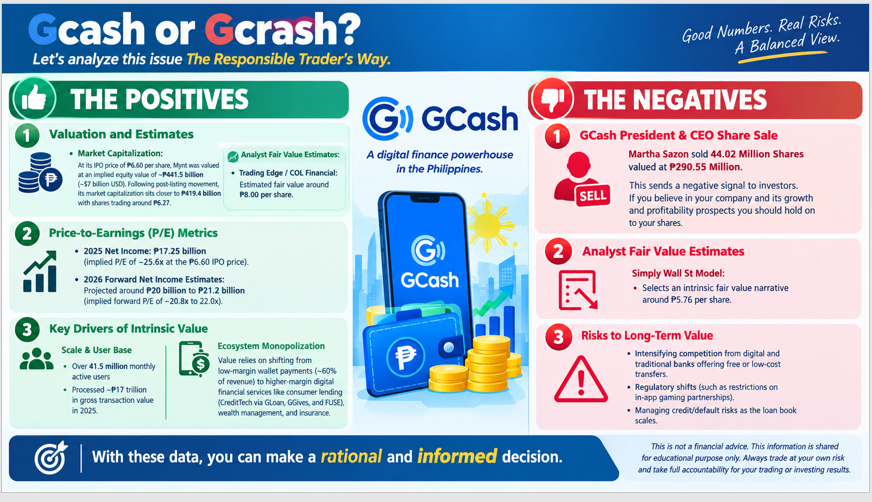
1. Valuation and Analyst Estimates
Market capitalization. At its IPO price of ₱6.60 per share, Mynt had an implied equity valuation of approximately ₱441.5 billion (around US$7 billion). Following post-listing price movements, the figures provided indicate a market capitalization closer to ₱419.4 billion, with shares trading at approximately ₱6.27.
Analyst fair value estimates. Trading Edge / COL Financial has been cited as estimating fair value at around ₱8.00 per share. If that estimate is supported by its underlying assumptions, it suggests potential upside from the cited trading price.
However, an analyst’s fair value estimate is not a guaranteed target. It depends on assumptions about earnings, growth, profitability, and risk.
2. Price-to-Earnings (P/E) Metrics
Based on the figures provided:
- 2025 net income: Approximately ₱17.25 billion, implying a P/E ratio of about 25.6 times at the ₱6.60 IPO price.
- 2026 projected net income: Approximately ₱20 billion to ₱21.2 billion, implying a forward P/E ratio of about 20.8 to 22.0 times.
These estimates suggest that the valuation could become more attractive if earnings continue to grow as projected. The key question is whether future earnings will meet expectations and whether that growth will translate into sustainable cash flows and shareholder value.
3. Key Drivers of Intrinsic Value
Scale and user base. GCash has established a significant presence in the Philippine digital wallet market. The figures provided cite more than 41.5 million monthly active users and approximately ₱17 trillion in gross transaction value for 2025.
A large user base and substantial transaction volume can create opportunities for customer engagement, cross-selling, and economies of scale.
Expansion into higher-value financial services. The investment case extends beyond basic wallet payments. The opportunity lies in growing higher-margin services such as consumer lending through GLoan, GGives, and FUSE, as well as wealth management and insurance.
The challenge is to turn this scale into durable, profitable growth while managing credit risk, operating costs, and competition.
Now, the Negatives
1. CEO Share Sale: A Signal Worth Examining
The figures provided state that GCash President and CEO Martha Sazon sold 44.02 million shares valued at approximately ₱290.55 million.
Such a transaction may raise questions among investors, particularly when they are evaluating management’s confidence in the company’s future prospects.
However, a share sale does not automatically mean that management lacks confidence in the business. Personal financial planning, diversification, transaction structure, and other circumstances may also explain a sale. Investors should examine the official disclosure, the nature of the transaction, and any remaining shareholdings before drawing conclusions.
The responsible approach is to investigate the facts rather than react to the headline alone.
2. A Lower Fair Value Estimate
Simply Wall St. model. The figures provided cite an intrinsic fair value estimate of approximately ₱5.76 per share.
This is notably below the cited IPO price of ₱6.60. If the model’s assumptions are reasonable, it suggests that investors could be paying more than the business’s estimated intrinsic value.
Fair value models can differ substantially because they use different assumptions about future growth, profitability, discount rates, and risk. Neither a bullish nor a bearish estimate should be accepted without examining its methodology.
3. Risks to Long-Term Value
Several risks could affect Mynt’s ability to sustain growth and justify its valuation:
- Intensifying competition: Digital banks and traditional financial institutions may offer free or low-cost transfers and other competing services, putting pressure on pricing and margins.
- Regulatory uncertainty: Changes in rules governing financial services and partnerships, including in-app gaming arrangements, could affect revenue opportunities and operating strategy.
- Credit and default risk: Expanding consumer lending can increase revenue, but poor underwriting or rising defaults could erode profitability.
- Execution risk: The company must convert its extensive user base and transaction volume into sustainable earnings and cash generation without compromising customer trust or financial discipline.
Growth is valuable only when it produces returns that justify the capital and risks involved.
The Responsible Trader’s Verdict
The investment case presents two competing narratives.
On the positive side, Mynt has a substantial digital ecosystem, significant transaction activity, and opportunities to expand into financial services. If earnings grow as projected and the company executes effectively, its long-term value could increase.
On the negative side, valuation remains sensitive to earnings assumptions, alternative fair value estimates suggest downside may be possible, and competition, regulation, and credit quality could weigh on future performance.
The CEO’s share sale is another factor worth investigating, but it should not be treated as conclusive evidence of the company’s prospects.
The bottom line: Do not buy solely because the growth story sounds attractive, and do not sell solely because a headline appears alarming. Compare the market price with defensible estimates of intrinsic value, assess the risks, verify the disclosures, and establish your own investment thesis.
#The Responsible Trader #Stock Trading #Philippine Stock Market